

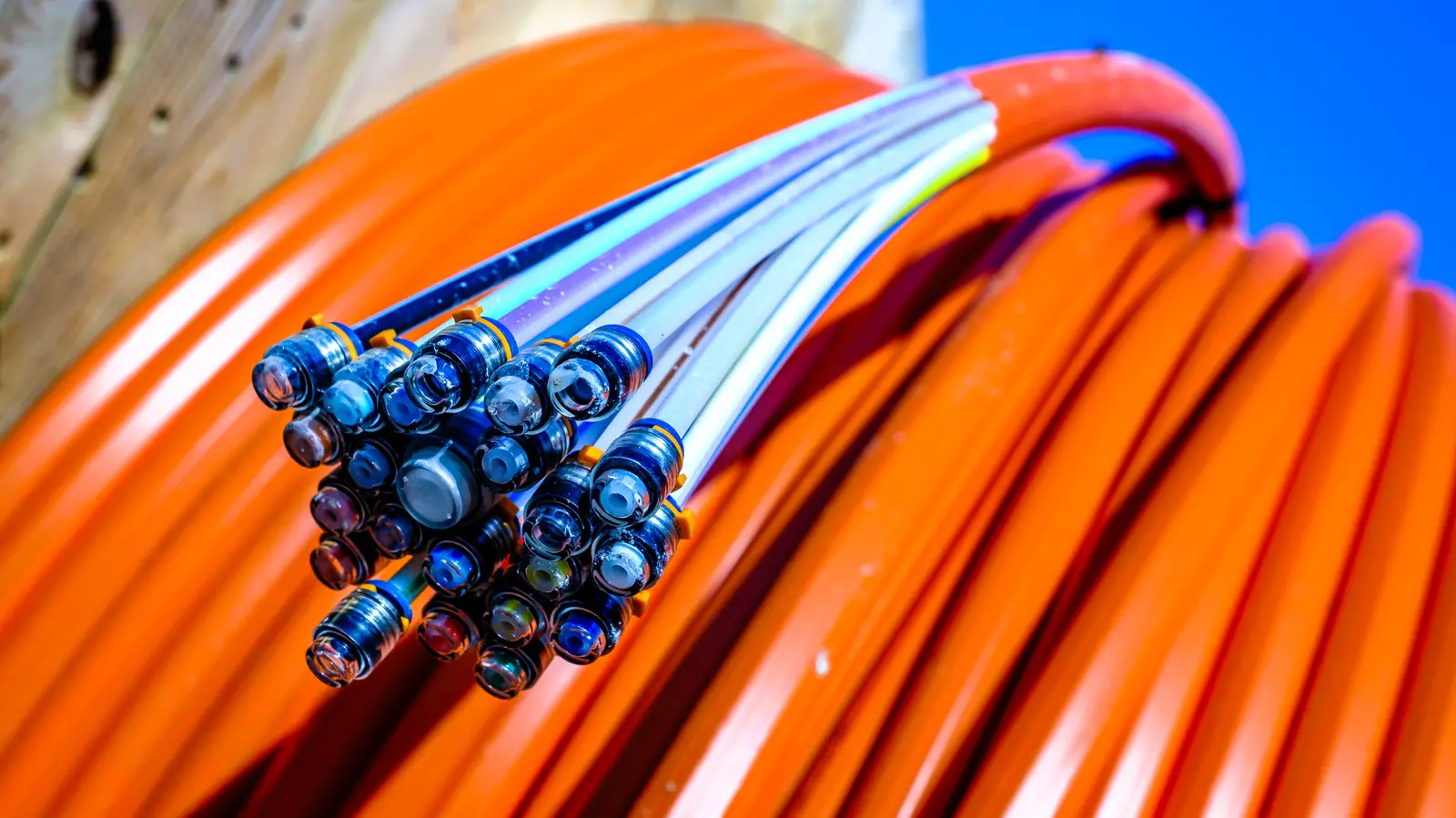
The Undersea Backbone of the Internet
The internet is often imagined as a wireless cloud, but the reality is far more grounded. Despite over 17,000 satellites orbiting Earth—including around 10,800 Starlink satellites as of July 2026—an estimated 98% of global internet traffic flows through fiber-optic cables laid across the ocean floor. This counterintuitive truth highlights the enduring superiority of physical cables for data transmission.
Key Facts: Cables vs. Satellites
- Bandwidth: The latest subsea cables achieve up to 400 terabits per second (Tbps) per cable, while the entire Starlink network aims for 800 Tbps by 2027.
- Latency: Fiber-optic cables offer lower latency than satellite links, crucial for real-time applications like video calls and online gaming.
- Reliability: Cables avoid weather interference and space debris risks, providing consistent performance.
- Cost: Laying a subsea cable costs between $250 million and $400 million, far less than the recurring expense of launching satellites (approx. $300,000 each for Starlink).
- Historical Legacy: The first successful transatlantic telegraph cable began operation in 1866; fiber-optic Atlantic cables arrived in 1988.
Why Subsea Cables Dominate
Fiber-optic cables are the workhorses of global connectivity. They transmit data as light pulses through strands of glass, enabling enormous bandwidth with minimal signal loss. The undersea cable network now spans over 920,000 miles—enough to reach the Moon and back nearly twice. These cables link continents and carry the bulk of financial transactions, streaming video, emails, and cloud services.
Satellites, in contrast, face inherent physical limitations. Signals travel at the speed of light, but the round trip to geostationary orbit (22,236 miles) introduces significant latency—around 600 ms, compared to less than 10 ms for a transatlantic cable. Low Earth orbit satellites like Starlink reduce latency to 20–40 ms, still higher than cables and subject to congestion and atmospheric interference. Furthermore, satellites require constant replenishment: the Starlink constellation alone launches thousands of units, each with a lifespan of about five years.
Historical Foundations of Subsea Connectivity
The dependence on subsea cables is not new. In 1851, the first telegraph cable crossed the English Channel. Seven years later, the first transatlantic telegraph cable connected Ireland to Newfoundland. Queen Victoria’s 98-word message to President Buchanan took 16 hours to transmit—a glaring contrast to modern speeds, but a revolutionary start. That early cable failed quickly, but by 1866 a durable link was established, proving the viability of undersea communication.
Fiber-optic technology replaced copper in the 1980s, with TAT-8, the first transatlantic fiber cable, going live in 1988. Today, hundreds of cables crisscross the oceans, operated by consortiums of telecom companies and tech giants. Each new generation pushes bandwidth higher—current cables use advanced wavelength division multiplexing to carry multiple channels simultaneously.
Reliability and Cost Advantages
Cables offer resilience that satellites cannot match. They are shielded against storms, solar flares, and space debris. Although vulnerable to ship anchors and earthquakes, cables are repairable via specialized vessels, and redundant routes ensure traffic reroutes around damage. Satellites face orbital congestion and potential collisions; the Kessler syndrome scenario—where debris cascades destroy satellites—remains a long-term risk.
From a financial perspective, subsea cables are a fixed infrastructure investment. Laying a cable costs hundreds of millions, but it lasts 25–30 years with regular upgrades to terminal equipment. Satellite systems require continuous launches and replacement of failed units, driving operational costs higher. SpaceX’s reusable rockets reduce launch costs, but the cumulative expense still exceeds cable maintenance.
Technological Maturity and Future Outlook
Cable technology is mature and constantly evolving. Research into hollow-core fibers promises even lower latency and higher speeds. Meanwhile, satellite internet serves niche markets: rural areas, maritime, aviation, and disaster recovery. For dense, high-demand urban corridors and backbone traffic, cables remain unparalleled.
Collaborations between cable and satellite providers are emerging. For example, data can travel via cable from New York to London, then via satellite to remote islands. This hybrid approach leverages each medium’s strengths. However, the core of the internet will stay underwater for the foreseeable future. As data demand grows—driven by AI, IoT, and 4K/8K video—new cables are being planned at a record pace.
The internet’s physical infrastructure is a marvel of engineering, hidden beneath the waves. While satellites capture headlines, the true lifeline of our connected world lies in the silent fibers spanning ocean floors. With capacity doubling every few years and costs declining, subsea cables will continue to deliver the vast majority of global data traffic, ensuring that even as we reach for the stars, our digital foundation remains solidly terrestrial.
Source:SlashGear News