

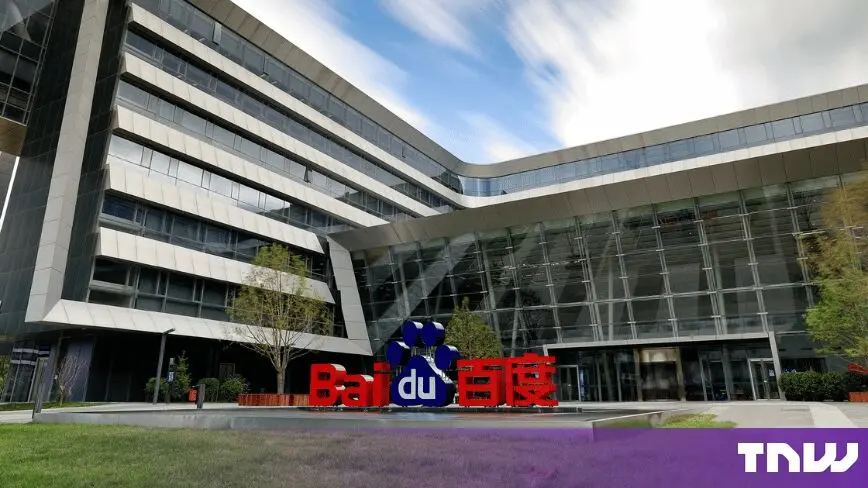
Baidu's revenue declined for the fifth consecutive quarter in the second quarter of 2025, as the company's traditional advertising business contracted faster than its rapidly growing artificial intelligence operations could compensate. The Chinese search giant reported quarterly revenue of RMB31.3 billion ($4.62 billion), a drop of 4 percent from the same period last year and 2 percent sequentially. Net income attributable to shareholders fell to RMB2.3 billion ($342 million), down sharply from RMB7.3 billion a year earlier, reflecting the heavy costs of the company's AI push. Shares listed in the United States fell as much as 10 percent to $93.70 in response, before paring some losses.
The revenue figure came in below analyst forecasts, which had ranged from RMB31.6 billion to RMB31.96 billion depending on the poll. Baidu has been struggling with a weak Chinese economy, a troubled property sector and cautious consumer spending, all of which have pressured the digital advertising market. The company is in the midst of a strategic transformation, shifting its focus from search-based marketing to AI cloud services, autonomous driving and generative AI models. But the two halves of the business are pulling in opposite directions, and the old side is still dragging down the overall numbers.
Two halves pulling apart
Online marketing revenue, which has historically been Baidu's mainstay, fell 19 percent year-on-year to RMB13.1 billion. The decline was attributed to reduced marketing budgets among advertisers, particularly in real estate and consumer goods, as companies tightened spending in response to macroeconomic headwinds. Baidu's search advertising business faces increasing competition from short-video platforms like Douyin and Kuaishou, which have captured a growing share of digital ad spend in China. The company has tried to offset this by integrating AI-generated content and conversational search, but advertisers have not yet returned in sufficient numbers.
Meanwhile, Baidu's AI-powered businesses are growing rapidly from a smaller base. The company's Core AI-powered Business segment generated RMB12.5 billion in revenue, up 25 percent from a year earlier. This segment now accounts for half of Baidu's general business revenue, up from nothing a few years ago. Within the AI segment, AI Cloud Infra revenue rose 50 percent to RMB7.3 billion, showing strong adoption of Baidu's cloud infrastructure for machine learning workloads. The most striking figure was GPU Cloud, the business of renting out AI accelerators such as Nvidia's chips. GPU Cloud revenue soared 283 percent year-on-year, accelerating from 184 percent growth in the previous quarter. Baidu renamed this line of business in the current quarter; it previously called it subscription revenue from AI accelerator infrastructure. The company said the surge reflects mounting demand for public cloud AI computing, as startups and established enterprises alike scramble to secure access to scarce AI chips.
The shift in Baidu's revenue mix is dramatic. In the first quarter, the AI segment passed half of core sales for the first time, and it held roughly steady in the second quarter. However, the absolute dollar growth in AI is still far smaller than the absolute decline in advertising. That gap is the core challenge facing Baidu as it tries to arrest the overall revenue slide.
Ernie falls behind rivals
One of the most worrying developments for Baidu is the apparent stagnation of its Ernie foundation model, which the company once touted as China's answer to GPT-4. According to industry watchers, Ernie has gone months without a major upgrade, while competitors have shipped newer and more capable models. Open-weight models such as Moonshot AI's Kimi have closed the performance gap with leading Western models like OpenAI's GPT-4 and Anthropic's Claude, and in some benchmarks they now match or exceed them. Ernie, once a frontrunner in China's AI race, is now seen as trailing these open-weight rivals.
Baidu's chief executive, Robin Li, acknowledged as much during the earnings call. He told analysts that Baidu would return Ernie to the frontier of AI. "In a market like this, we believe long-term competitiveness ultimately comes down to sustained technology investment, application-driven approach, and patience," he said. Li's comments suggest that Baidu is doubling down on its model development rather than ceding ground. The company has one of the largest AI research teams in China and has invested heavily in its own chips and data centers. But catching up may not be easy, because rivals are moving fast. Alibaba's Qwen model has been steadily increasing in size and capability, and Moonshot trained its latest Kimi K3 model on 20,000 Nvidia chips rented through Alibaba's cloud. This competitive dynamic means Baidu must continue to spend heavily just to stay relevant.
Ernie is not just a showcase technology; it is integrated into Baidu's cloud services and its search engine. An upgrade to Ernie would improve the quality of AI-generated answers, which could help to stem the decline in advertising revenue by making search more engaging. But the company has not yet released a flagship model upgrade this year, and the next version will be closely watched.
The AI bet is expensive
Baidu's aggressive investment in AI is showing up in its capital expenditure. Excluding its streaming unit iQIYI, Baidu's capex tripled in the second quarter to RMB11.4 billion, up from RMB3.78 billion a year earlier. The money is going into chips, servers and data centers to support its AI cloud and model training operations. This spending is expected to keep pressuring margins even as AI revenue climbs. Analysts note that Baidu is not alone in this squeeze: rival Tencent reported this month that its AI compute bill grew faster than its cash flow, following the same pattern of heavy upfront investment in models that have not yet generated meaningful returns.
Despite the spending, Baidu's balance sheet remains robust. The company reported RMB283.1 billion ($41.72 billion) in total cash and investments, and operating cash flow of RMB3.4 billion, marking a fourth consecutive quarter of positive operating cash flow. Baidu has also been returning capital to shareholders, spending $259 million on share buybacks since the start of the year under a program introduced alongside its first-ever dividend in February. The company's financial firepower gives it the ability to continue investing in AI for several more years, but the pressure to show a payoff is growing.
Baidu's AI cloud business has the advantage of owning a significant share of China's public cloud AI infrastructure. As Chinese companies face restrictions on buying advanced chips, domestic alternatives like Baidu's own Kunlunxin chips are becoming more relevant. Kunlunxin is a separate unit that Baidu is spinning off through a Hong Kong listing, allowing the company to raise capital for its chip development and giving investors a direct stake in China's silicon independence efforts. The spin-off could also reduce Baidu's overall capital intensity over time.
Robotaxis and a Hong Kong listing
Beyond cloud and models, Baidu is leaning heavily on autonomous driving to generate future revenue. Its Apollo Go robotaxi service has expanded to 28 cities and has logged more than 350 million autonomous kilometres, with over 240 million of those fully driverless. The service has begun open-road testing in London in partnership with Uber and Lyft, launched driverless commercial rides in Dubai, and received Hong Kong's first fully driverless testing permits. That international expansion follows a regulatory pause in China. A fleet outage in Wuhan in April triggered an industry-wide safety review and a three-month freeze on new robotaxi permits. The freeze has since been lifted, and Apollo Go is resuming its expansion at home.
Baidu's robotaxi business is still loss-making, as the company must purchase expensive vehicles and sensors and operate a round-the-clock service. But the company believes that once the fleet is large enough and the technology is sufficiently reliable, unit economics will improve. The global expansion into markets like the Middle East and Europe is intended to accelerate this by increasing utilization rates.
On the corporate side, Baidu said its dual-primary listing in Hong Kong should take effect this year. This will give mainland Chinese investors direct access to Baidu shares, as they currently trade primarily on the Nasdaq and in Hong Kong via a secondary listing. A dual-primary listing also allows the stock to be included in more indices, potentially attracting new investment. The company is also spinning off Kunlunxin, its chip unit, which is targeting a Hong Kong listing to tap investor demand for local alternatives to Nvidia. These corporate actions are part of a broader effort to reposition Baidu as a technology pioneer rather than a legacy internet ad company.
Baidu's flagship app still reaches 644 million monthly active users, according to the company's earnings release. That gives it a large base to sell AI features into. The company has been rolling out AI assistants, generative search and personalization tools within the app, aiming to increase user engagement and eventually convert usage into revenue. The user base is stable, but the advertising market remains weak, and monetization of AI features is still in its early stages.
Whether the pivot pays is unproven
Not every analyst is convinced the AI push can carry Baidu. Some have expressed doubt that Baidu can turn its AI businesses profitable, given the lack of scale relative to China's largest platforms. One analyst at a financial intelligence firm argued that Baidu's prospects rest on turning money-losing AI businesses into profitable operations, and doubts that it can because it lacks the scale to compete with Tencent, Alibaba and ByteDance. These competitors have larger cloud ecosystems, stronger cash flows and broader distribution networks. Baidu's AI cloud business, while growing fast, is still a relatively small player in China's cloud market, which is dominated by Alibaba and Huawei.
Three numbers would settle the question over the coming quarters. The first is whether AI Cloud growth keeps outrunning the advertising decline in absolute terms, not just in percentage terms. A 50 percent increase in a small base may not offset a 19 percent decline in a larger one. The second is whether the tripled capital spending starts converting into profit rather than eroding it. Baidu needs to show that its AI infrastructure can generate operating leverage and margin expansion. The third is whether an upgraded Ernie model can actually close the gap on Moonshot and Alibaba that has opened this year. A competitive Ernie would strengthen Baidu's cloud sales and improve its search product.
None of those answers is available yet, but the next few quarters will be decisive. Baidu is making a bold bet that it can reinvent itself as an AI-first company, but the evidence so far shows that the old business is still shrinking faster than the new business is growing. The company's cash position gives it time, but the clock is ticking. If the AI segment does not begin to dominate the overall revenue picture, and fast, Baidu may be stuck in a persistent state of decline.
Source:TNW | Business News