

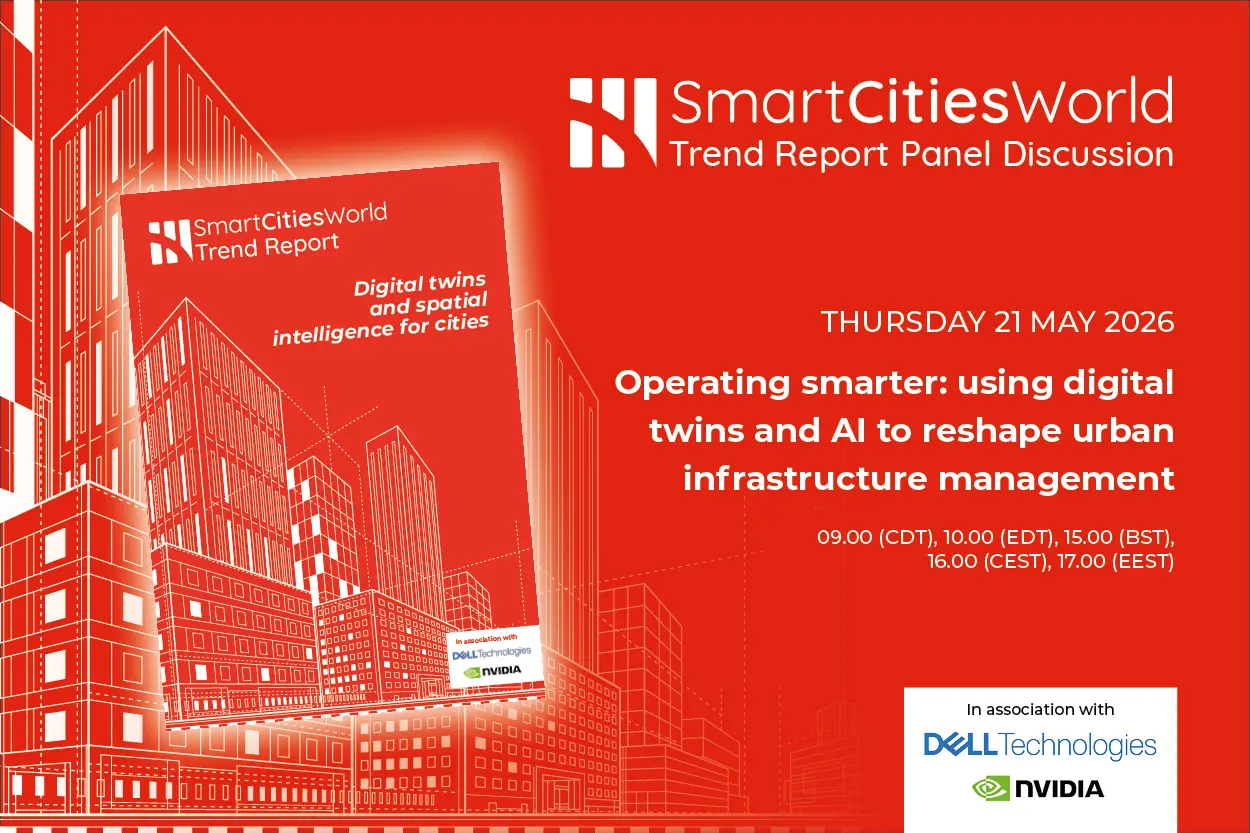
Urban infrastructure is at a crossroads. Across the world, city authorities are being asked to do more with fewer resources, to respond to climate pressures and to deliver services that meet rising public expectations. The traditional pattern of reactive maintenance, fragmented data and separate departmental systems is becoming harder to defend. Increasingly, the conversation has moved towards a strategic, risk-based approach in which digital twins and artificial intelligence help city leaders understand what is happening now, anticipate what is likely to happen next, and target investment where it will have the most impact. This was the central theme running through a series of Summit 2026 panel discussions and on-demand contributions focused on urban infrastructure management.
Key facts
- Summit 2026 features a panel on moving cities toward risk-based infrastructure resilience using AI and digital twins.
- A second panel examines how local authorities can shape energy systems through renewables, flexibility, storage and smarter networks.
- Juan Carlos Lopez of Cayala discusses agile transformation, digital infrastructure and community-led services in one of Central America’s largest private cities.
- Sunderland’s smart city programme is delivering measurable economic, social and public-service benefits.
- Singapore continues to strengthen its position as a global leader in smart-city development.
- Professor Jung Hoon Lee warns of an emerging “AI super gap” between cities and calls for data platforms, AI-ready infrastructure and effective governance.
- Microsoft’s Katherine Flesh says transport AI success depends on data foundations, workforce readiness and responsible governance.
- Ecomondo highlights priorities for healthier, more sustainable cities and the value of sharing practical solutions.
A strategic turn towards resilience
One of the most prominent discussions explored how cities can move away from fixing assets after they fail and towards a more predictive, risk-led model. The panel looked at the role of digital twins, which are dynamic virtual replicas of physical infrastructure that can be updated with live data from sensors, telemetry and operational systems. These tools allow engineers to simulate a flood, a power cut or a failure in a transport corridor before it happens, test different responses, and make evidence-based decisions. The discussions also touched on governance, data quality and interoperability, because a digital twin is only as useful as the information feeding into it. City leaders need clear frameworks for data sharing, privacy and accountability.
A related panel focused on energy systems and the ability of local authorities to shape them. The message was that municipalities are no longer passive consumers of energy. Through investment in renewables, demand-side flexibility, battery storage and smarter distribution networks, they can reduce emissions, lower costs and improve resilience. The session highlighted the need for cross-departmental collaboration and strong relationships with utility providers, developers and communities. It also stressed the importance of integrating energy planning with other infrastructure strategies, including transport, housing and digital connectivity.
Cayala: agile transformation in a private city
One case study that brought many of these themes to life came from Cayala, one of Central America’s largest private cities. Juan Carlos Lopez, its Chief Technology Officer and Chief of the Value Management Office, explained how agile transformation, digital infrastructure and community-led services are supporting the expansion of the development. Cayala is not just a real estate project; it is an attempt to build a liveable urban environment from the ground up, with mixed-use streets, public spaces, commercial districts and residential neighbourhoods. Lopez described how digital tools are embedded into the management of the city, helping operators respond quickly to residents’ needs while maintaining a long-term vision for sustainable growth. The use of agile methods means that delivery teams can adapt as requirements change, rather than being locked into rigid plans. Community-led services, meanwhile, ensure that residents are involved in shaping the digital experience of their city.
Sunderland: measurable benefits from long-term vision
Another example came from Sunderland, whose long-running smart city programme is now showing measurable economic, social and public-service benefits. New research demonstrates the effects of long-term investment in connectivity, civic leadership and trusted partnerships. The city has pursued a strategy based on digital infrastructure and low-carbon innovation, positioning itself as a resilient, future-focused economy. The approach has involved collaboration across the public and private sectors, with a strong emphasis on practical outcomes rather than technology for its own sake. The Sunderland experience underlines an important lesson for cities: smart city success is not simply about installing sensors or launching apps. It requires sustained commitment, clear governance and a willingness to measure and communicate results.
Singapore: building a connected smart nation
Singapore also featured prominently in the programme, reinforcing its reputation as one of the world’s smartest nations. The island city-state has spent years building integrated digital infrastructure around its Smart Nation initiative. Government services, urban planning, transport, health and public safety all draw on shared data platforms and strong institutional coordination. What makes Singapore interesting is not any single technology, but the way different systems connect to one another. The city has used simulation, AI and sensor networks to manage everything from crowd flows and public housing maintenance to water supply and traffic. Its consistency in investing in research, digital skills and regulatory frameworks explains why it continues to appear near the top of international rankings.
Closing the AI gap between cities
The summit also offered a deeper dive into how AI is moving from pilots to real-world impact. Professor Jung Hoon Lee joined the programme to discuss the latest Global Smart City Index and the emerging “AI super gap” between cities. His central argument is that cities that build strong data platforms, AI-ready infrastructure and effective governance will accelerate ahead, while those that rely on small, disconnected experiments may fall behind. The gap is not only about financial resources; it is about leadership, institutional readiness and the ability to use data responsibly. Professor Lee also highlighted the importance of creating public trust, particularly as AI systems begin to influence decisions about policing, welfare, planning and transport.
AI in transport: more than technology
Transport is one of the areas where AI may deliver the most immediate and visible gains. Yet, as Microsoft’s Katherine Flesh pointed out, technology alone is not enough. The greatest opportunities for transport agencies will depend on strong data foundations, workforce readiness and responsible governance. Agencies are already using AI to improve traffic signal timing, detect defects on rails and roads, plan maintenance, predict passenger demand and provide better real-time information. But if data is siloed, inconsistent or poor quality, AI models will struggle. Equally, a well-trained workforce needs to trust the outputs of automated systems and understand their limitations. Flesh’s comments served as a reminder that AI transformation is an organisational change process as much as a technical one.
Priorities for healthier, more sustainable cities
Sustainability was another major theme, with Ecomondo discussing the priorities that are shaping healthier, more sustainable cities. The emphasis was on practical solutions that can be shared across borders, and on the value of building new connections between city leaders, industry experts and researchers. Ecomondo’s contribution pointed to the importance of dealing with air pollution, waste, water management and public health in ways that are both ambitious and realistic. These issues cannot be solved by one department or one generation. They require long-term commitment and collaboration.
More on-demand sessions and resources
Two further on-demand sessions were highlighted in the programme. One panel focused on unlocking value in cities from buildings, data and AI, looking at the relationship between the physical built environment and the digital systems that run through it. Another session dealt with how AI and data are transforming transport operations and services, covering topics such as predictive maintenance, autonomous vehicles and integrated ticketing. Together, these sessions reinforced the message that cities need to think about infrastructure as an interconnected system of physical assets, digital services and human capabilities.
To support ongoing learning, the programme also promoted an editorial newsletter that brings together the latest news, city interviews, special reports and guest opinions. For busy professionals, such a resource offers a straightforward way to keep up with a rapidly changing field.
Source:Smart Cities World News