

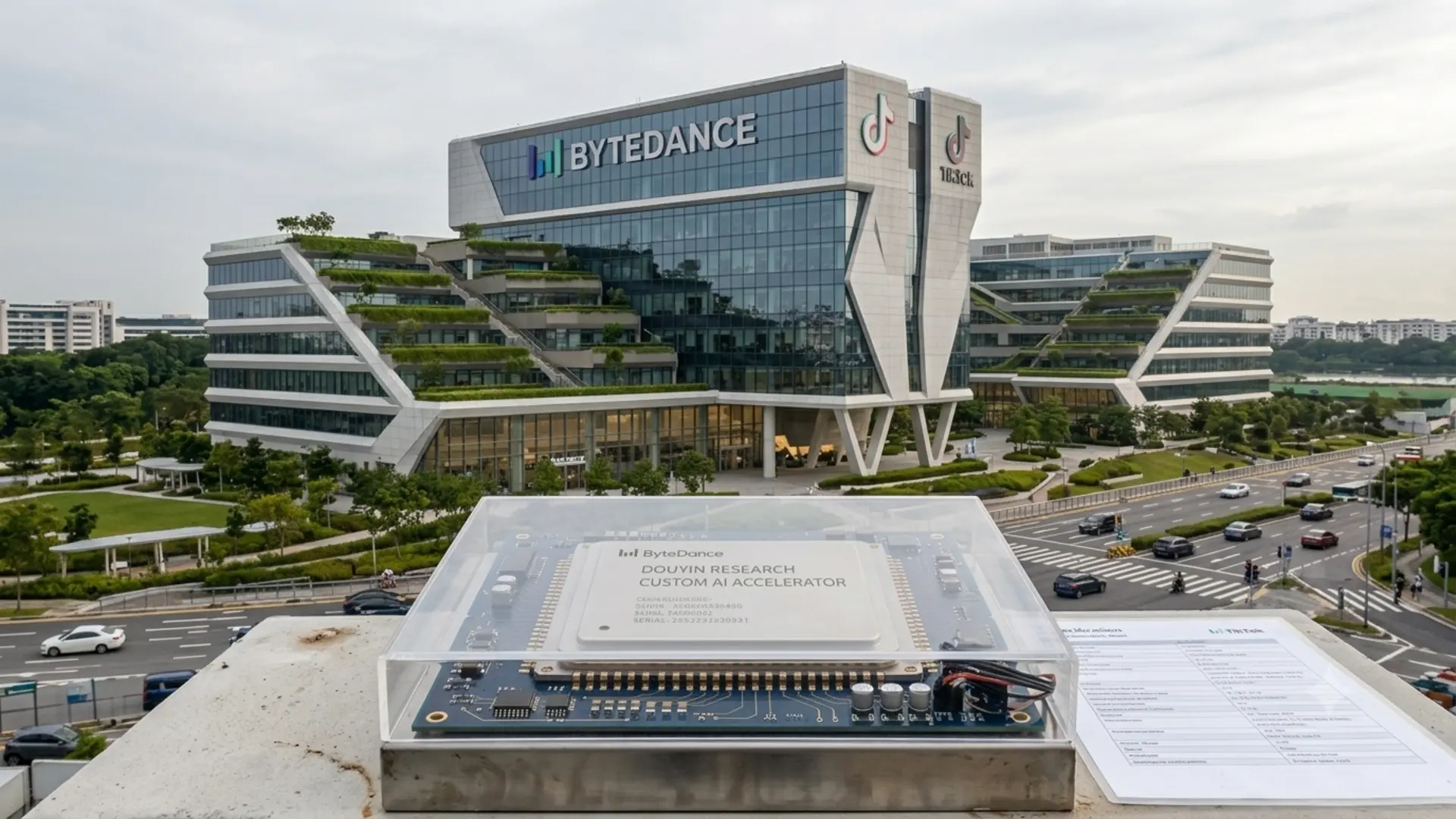
ByteDance, the Chinese internet giant best known for owning the TikTok and Douyin short-video platforms, is reportedly developing an artificial intelligence accelerator chip designed to rival Nvidia's industry-leading hardware. According to sources familiar with the matter, the company aims to complete the project within a few months, a timeline that has surprised many industry watchers given the complexity of designing and manufacturing competitive AI chips.
The initiative underscores ByteDance's deepening commitment to artificial intelligence, an area where the company has already made significant investments. ByteDance's recommendation algorithms, which power TikTok's addictive feed, rely heavily on AI models trained and deployed on massive computing clusters. Until now, those clusters have been built largely with Nvidia GPUs, such as the A100 and H100 series. But geopolitical tensions and supply chain uncertainties have prompted ByteDance, like many of its Chinese peers, to explore domestic alternatives.
Details of the Chip Project
Though ByteDance has not publicly confirmed the project, multiple reports indicate that the company has assembled a team of chip engineers with experience at leading semiconductor firms. The team is working on an accelerator specifically optimized for deep learning workloads, including training and inference for large language models and recommendation systems. The chip is expected to be manufactured using advanced process nodes, likely 7nm or 5nm, through partnerships with suppliers such as TSMC or possibly Chinese foundries like SMIC.
The decision to take on Nvidia, a company with decades of experience and a dominant software ecosystem (CUDA), is bold. ByteDance will need not only competitive hardware but also a robust software stack to make it easy for developers to port existing models. The company has already been investing in open-source AI frameworks and may leverage its in-house software expertise to address this challenge.
Context: US-China Tech Rivalry
The development comes against a backdrop of escalating US sanctions on Chinese technology firms. The Biden administration has imposed strict export controls on advanced semiconductors and manufacturing equipment, making it harder for Chinese companies to acquire Nvidia's highest-performance chips. ByteDance itself has been subject to political scrutiny in the US, with calls for a ban on TikTok over national security concerns. Building its own AI accelerator would reduce ByteDance's dependence on US-origin components and insulate it from future restrictions.
China's semiconductor industry has been under intense pressure to become self-sufficient. President Xi Jinping has made chip independence a top national priority. Companies like Huawei have already released their own AI chips, such as the Ascend series. ByteDance's entry would add a powerful new player to the domestic AI chip landscape.
Nvidia's Dominance
Nvidia currently commands roughly 80-90% of the market for AI training chips. Its GPUs are integral to the massive clusters used by companies like OpenAI, Meta, and Google. The company's H100 Hopper GPU, launched last year, is coveted by data center operators worldwide. Nvidia's lead is not just in raw performance but in its CUDA software platform, which has become the de facto standard for AI development.
Challenging Nvidia will require more than just hardware parity. ByteDance would need to offer a compelling software toolchain or, alternatively, target workloads where Nvidia's ecosystem is less entrenched. Some analysts suggest ByteDance could focus on inference rather than training, as inference chips tend to be simpler to design and less dependent on ecosystem lock-in.
ByteDance's AI Ambitions
ByteDance has been quietly building AI capabilities for years. In 2021, it launched the ByteDance AI Lab, which focuses on natural language processing, computer vision, and recommendation systems. The company also operates a cloud computing division, Volcano Engine, which could eventually offer the new chip as a service to clients. Given ByteDance's vast user base and data, the chip would likely first be deployed in its own data centers to optimize costs and performance for TikTok's recommendation engine.
Additionally, ByteDance has been experimenting with generative AI, including large language models similar to ChatGPT. The company released a chatbot called Doubao in China and has integrated AI features into its apps. Running such models at scale requires enormous computational resources. A custom accelerator could yield significant efficiency gains and cost savings.
Technical and Financial Challenges
Designing a competitive AI accelerator from scratch is a multi-billion-dollar undertaking. Even established players like Intel and AMD have struggled to erode Nvidia's market share. ByteDance, despite its immense revenue from advertising, must also navigate a difficult funding environment for Chinese tech firms amidst regulatory crackdowns. Moreover, advanced chip fabrication is largely concentrated outside China. TSMC, the world's leading foundry, is based in Taiwan and operates under geopolitical risks. Chinese foundries like SMIC are capable of producing only older node chips (14nm and above), which may not be competitive with Nvidia's latest offerings.
Nevertheless, ByteDance's aggressive timeline suggests it may be targeting a specific niche or leveraging existing design IP. Some reports indicate the chip is based on RISC-V, an open-source instruction set architecture that is gaining traction in China. Using RISC-V would allow ByteDance to avoid licensing fees from Arm or Intel and potentially customize the core extensively.
Potential Impact
If ByteDance succeeds in delivering a competitive AI accelerator within months, it would be a major milestone for China's semiconductor industry. It would demonstrate that Chinese companies can design and manufacture cutting-edge chips despite sanctions. It would also provide ByteDance with a strategic advantage over rivals like Tencent and Alibaba, which also rely on Nvidia chips for their AI workloads.
However, even with a working chip, mass adoption will take time. Software optimization and developer trust are not built overnight. Moreover, Nvidia is not standing still; it is already developing next-generation platforms like the Blackwell GPU. ByteDance's entry may not dethrone Nvidia but could create a more diversified market, benefiting cloud customers and accelerating innovation.
The broader implications extend to the geopolitical chessboard. A homegrown ByteDance chip could reduce China's vulnerability to export controls, giving Beijing more leverage in trade negotiations. At the same time, it may prompt the US to tighten restrictions further, leading to a tech decoupling that hurts both economies.
In the coming months, all eyes will be on ByteDance's chip team to see if they can deliver on the ambitious promise. The outcome will not only shape the company's future but also signal the direction of the global AI hardware landscape.
Source:TechRadar News