

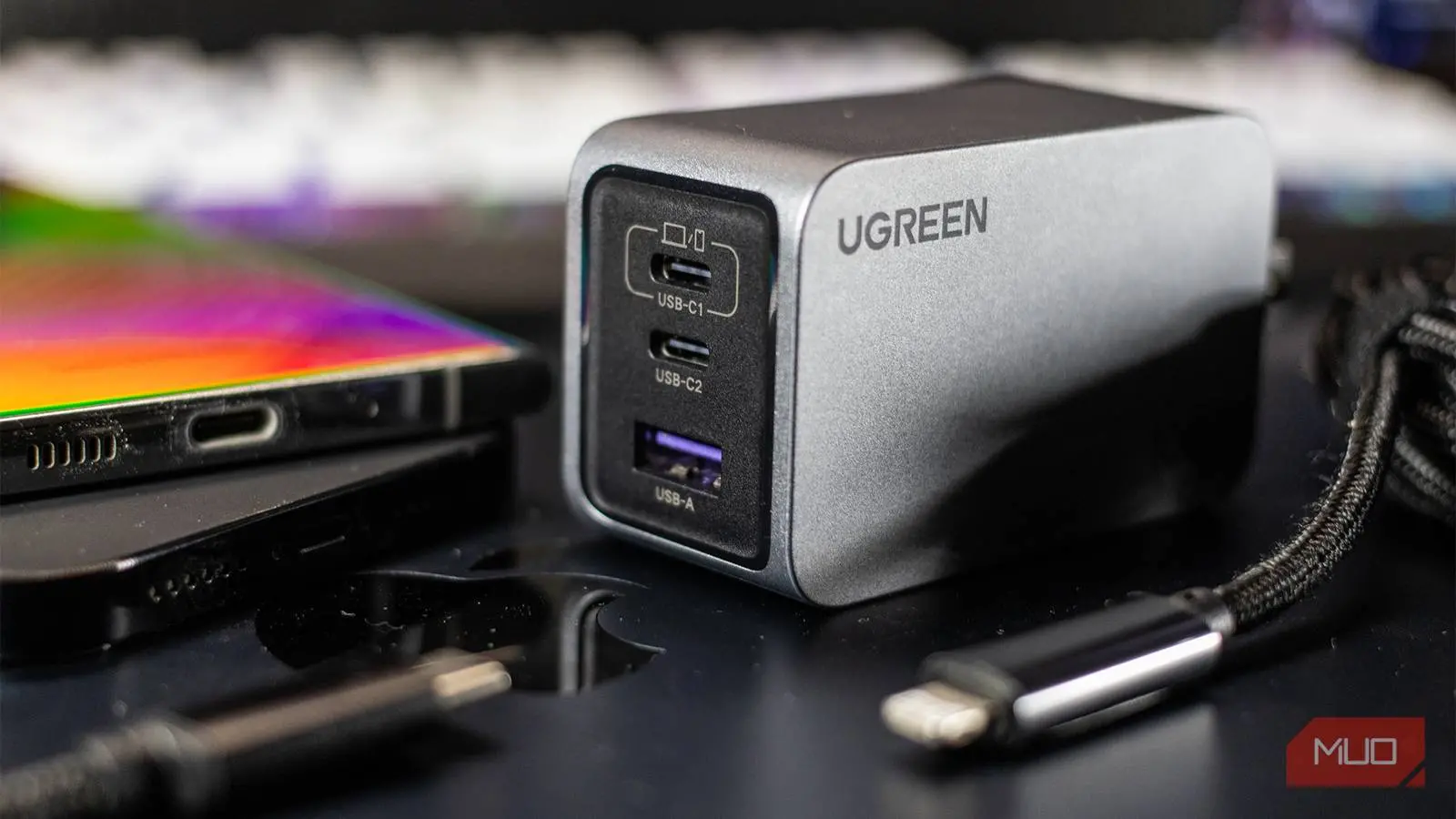
Buying a phone charger wasn’t even something you had to think about back when brands were nice enough to include one in the box. Those days are mostly gone. And if you’ve gone charger shopping recently, you probably know how confusing it can get with all those wattage numbers and acronyms like PD, PPS, and GaN. I’ve been there too. But once you know what they each mean, picking the right charger gets a lot simpler.
Buying the right phone charger can be confusing
It’s no longer just about USB-A or USB-C
The biggest reason buying a charger can be confusing is that almost every charger will technically work with your phone. It’s no longer just about getting a charger with the right port. Yes, USB-C is everywhere, and it should have simplified things — but that hasn't happened. Even if two chargers look identical, they might perform completely differently.
You can use a 5W charger from five years ago, and your phone will still charge. But “works” and “works correctly” aren’t the same thing here. Beyond wattage, you need to see if the charger supports advanced charging technologies like PD, PPS, and GaN. Again, your phone will still charge without these, but you might be leaving a ton of speed on the table, or paying a premium for wattage your phone can’t even use.
USB PD, PPS, QC, and GaN all mean different things
A plain-English breakdown of each term
When buying a charger, you’ll run into terms like PD, PPS, QC, and GaN. Each one tells you what's special about the brick.
USB Power Delivery (USB PD) is a charging standard that lets a charger and your phone negotiate how much power gets delivered. Instead of supplying a fixed voltage, the charger and device can talk to each other and agree on the safest, fastest combination. Almost every modern Android phone supports it, and it’s the reason why some chargers can fast charge your phone, laptop, and even a pair of earbuds without frying any of them. PD is widely adopted and is often required for charging devices like MacBooks and Nintendo Switch.
Programmable Power Supply (PPS) does the same thing as USB PD but slightly better. Instead of adjusting the power in phases, it does it continuously. That means a PPS charger can keep the heat low and efficiency high, which is good for long-term battery health. Many Samsung and Google phones rely on PPS to reach their maximum charging speeds, so if you own one, a non-PPS charger will charge slower than advertised.
Then there are proprietary technologies from different companies. For instance, Qualcomm has Quick Charge (QC) for phones running Snapdragon chips (though it is licensable by non-Snapdragon devices), and it comes in various versions like QC 2.0, 3.0, and 4.0+. You want to pick the highest version your phone supports. Phone brands have their own protocols, like OPPO's SuperVOOC and Motorola’s TurboPower. These typically need both the charger and the phone to be from the same brand to achieve those advertised charging speeds. However, many modern PD chargers can still charge such phones at standard speeds.
Gallium Nitride (GaN) is a different thing entirely. It’s not a charging protocol but the material used inside the charger. Traditional chargers use silicon components, but GaN chargers use a newer semiconductor that runs more efficiently and generates less heat. The obvious benefit is a charger that’s significantly smaller and lighter for the same wattage. GaN chargers are ideal for travel because they pack high power into a compact size, often with multiple ports.
More watts don’t always mean faster charging
Stop chasing the highest number
This is probably the most common mistake people make when buying a charger. Wattage isn’t something the charger decides alone. Your phone has a maximum charging rate built into it, and it’ll never exceed that, no matter what you plug in. For instance, my Galaxy S26 tops out at 25W, which means there’s no point in buying a 45W charger. It’ll be as effective as a 25W one. Similarly, an iPhone 15 Pro maxes out at 27W, so a 65W charger won't charge it any faster.
There’s another wrinkle. The wattage you see on the charger’s box is a maximum output, not a guarantee of what each device will get. So if you get a multi-port charger, don’t expect it to charge all your devices at the maximum rate mentioned on the box. The charger will split the output between connected devices, and the exact split depends on the charger’s internal design. For example, a 65W dual-port charger might provide 45W to one device and 18W to another when both are plugged in.
Always check your phone’s max charging wattage first — you can usually find it in the specs on the manufacturer’s website or by searching online. Then buy a charger that matches or slightly exceeds that value. Using a charger rated higher than the phone’s limit is safe (the phone controls the current), but you’re just wasting money on unused capability.
The cable matters just as much
You can buy the perfect charger and still end up with slow charging if the cable doesn’t keep up. If your phone and charger are both capable of 65W, but the cable maxes out at 15W, that’s what you’ll get. This usually isn’t a problem since most manufacturers still include the cable in the box (at least for now). But if you’re using a spare one for your office or travel bag, don’t just grab a random USB-C cable. Look for cables rated for 60W or 100W — these are often labeled as USB-IF certified. Some cables also support data transfer speeds like 10Gbps, but that’s separate from charging.
Finally, with both the charger and the cable, stick to a reputable brand. You might find a no-name charging brick or cable with the same specs on the packaging, but you’ll have to take their word for it. Cheap chargers often lack crucial safety features like overvoltage protection, temperature regulation, and proper insulation. They can overheat, damage your device’s battery, or even cause fires. Brands like Anker, Belkin, Spigen, and official OEM chargers are worth the extra cost for peace of mind.
In the early 2010s, most phones used micro-USB and came with proprietary chargers that couldn’t be swapped. The transition to USB-C was supposed to unify charging, but it instead introduced a new layer of complexity with power delivery profiles. Understanding these terms helps you avoid the trap of buying an expensive high-wattage charger that your phone can’t fully utilize, or a cheap charger that degrades your battery over time. The next time you upgrade your phone, check the box for supported protocols like PD 3.0 with PPS, and pair it with a quality cable. Your phone will thank you with a long and healthy battery life.
Source:MakeUseOf News